List of contents
Do you know about the types and methods of controlling rubber plant pests and diseases? Rubber plants are annual plants that can continue to grow for up to 30 years.
Rubber plants are not native to Indonesia, although the development of rubber plants in Indonesia is very rapid.
Types and Methods of Controlling Rubber Plant Pests
1. Snail
Slugs are pests of rubber plants that eat the leaves of rubber plants. Symptoms of a rubber plant being attacked by snails are the leaves on the rubber plant breaking.
On the broken leaves there are shiny silvery grooves which are snail tracks.
There are two ways to control slugs on rubber plants, namely mechanical control and chemical control.
The type of mechanical control is by searching for and collecting snails on rubber plants then burning or burying the snails away from the rubber plants.
Chemical control means making bait to catch snails, namely from a mixture of bran, cement, lime and radex in a ratio of 16:3:5:2 which must be moistened first by adding a little water and then placing it around the rubber plant. Snails that eat this mixture will die.
2. Locust
Grasshoppers are pests that attack rubber plants during the seeding phase. Grasshoppers will eat young rubber plant leaves. If the young rubber plant leaves are gone, the grasshoppers will eat old rubber plant leaves.
The way to control grasshopper pests on rubber plants is to spray the Thiodan insecticide according to the dosage once every 1 to 2 weeks.
3. Mice
In the germination and seedling phase, rubber plants are usually attacked by rat pests. Rats will eat the seeds of rubber plants and eat the leaves of young rubber plant seeds.
Rat pests on rubber plants cannot be allowed because they will damage rubber plants, therefore the way to prevent this is to protect the germination site so that rats do not enter it.
To protect the germination site for rubber plants, cover it with wire mesh.
4. Termites
Termites of the species Microtermes Inspiratus and Captotermes Curvignathus are pests of rubber plants that can eat away at newly planted rubber plant seeds.
These termites eat away at the tip of the stum down to the roots so that the rubber plant becomes very damaged.
To control termites in rubber plants, you can do it in 3 ways, namely technical, chemical and mechanical control.
The technical control is to wrap the tip of the stum until just above the eye with plastic so that the termites don’t eat it.
Meanwhile, mechanical control is by planting bait, for example 2 to 3 cassava stems, and placing them at a distance of 20 to 30 cm from the seeds so that the termites will eat the bait.
Chemical control is by spraying termite-killing insecticides such as Furadan 3G, a dose of 10 grams which is sprinkled on the area around the rubber plant stem.
5. Clock Tanah
Have you ever heard of soil pests? Groundworm is the larval phase of several types of beetles, namely Anomala Varians, Helotrichia Serrata, Exopholis Sp. And so forth. Soil rubber can attack rubber plants that are still in the form of seedlings.
To prevent soil rubber pest attacks, sprinkle Furadan 3 G according to the dosage when preparing the rubber plant nursery area.
If the rubber plant has already been affected by soil worm pests, there are two ways to control it, namely chemically and technically.
Chemical control is by sprinkling Furadan 3 G and Diazinon 10 G around the rubber plants.
6. Lice
Fleas are one of the pests that can attack rubber plants, where the types of fleas that attack rubber plants are Saissetia Nigra, Planococcus Citri and Laccifer Greeni.
The characteristics of rubber plants that are attacked by flea pests are that the tops of the stems and young leaves are yellow and dry, causing the parts of the rubber plant affected by flea pests to die.
Controlling fleas can be done in 3 ways, namely destroying the parts of the rubber plant affected by fleas, spreading the natural enemies of fleas, namely beetles, and eradicating fleas using flea-killing pesticides.
Types and Methods of Controlling Rubber Plant Diseases
Apart from being attacked by pests, rubber plants can also be attacked by diseases that can attack the roots, stems and leaves. Some of the rubber plant diseases are as follows:
1. White Root Fungus Disease
White Root Fungus Disease which can attack rubber plants is caused by the fungus Rigidoporus Lignosus or R. Micropus.
If a rubber plant is attacked by white root fungus, the symptoms are that the rubber plant dies suddenly, fruit forms on the young rubber plant even though it is not yet ripe, the leaves are dark green and dull and wrinkled and the surface of the rubber plant’s leaves turns down.
On the surface of the roots there are yellowish-white threads attached and flat, resembling hair roots that are firmly attached and therefore difficult to remove.
Next, the roots will rot and turn brown and the texture of the roots will become soft.
To control white root disease in rubber plants can be done in 3 ways, namely technical, biological and chemical culture
Control using technical culture is collecting remaining roots and stumps in rubber plantations as an effort to get rid of the fungus that causes white root disease in rubber plants.
This type of biological control can be done by applying Trichoderma Koningii around the rubber plants to destroy the fungus that causes this disease.
Chemical control is by using a fungicide in the form of Anvil to eradicate the fungus that causes white root disease.
2. Stem Disease
Stem disease in rubber plants is caused by the fungus Fusarium Solani which is associated with Botrydiplodia.
The symptoms shown by rubber plants affected by this disease are blackish brown spots appearing on the surface of the rubber plant’s skin.
These spots can enlarge to cover the entire bark of the rubber plant, causing the stem to rot.
Then this disease will develop in the inner skin layer of the rubber plant and damage the cambium layer and even the wood layer of the rubber plant.
This stem disease can be controlled by administering Functiona and rotting stems must be discarded immediately.
3. Leaf Disease
There are 2 types of leaf diseases on rubber plants, namely Colletotrichum leaf disease and Phytophthora leaf disease.
Colletotrichum leaf disease attacks young leaves so that the leaves fall. Phytophthora leaf disease is caused by the fungus Phytophthora sp. which forms the zoosporangium.
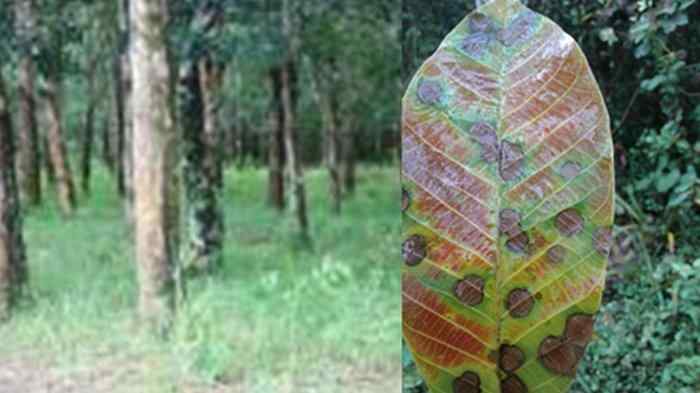
The characteristics of rubber plants affected by Phytophthora leaf disease are that the leaves fall while the rubber plant leaves are still attached to the stems.
Another characteristic is that the leaf stalks of rubber plants have dark brown or black spots with white spots in the middle.
Rubber plant leaves that fall due to this disease are green like healthy leaves.
Prevention for rubber plants affected by Phytophthora leaf disease is to spray Cobox fungicide according to the dosage.
Prevention for rubber plants affected by Colletotrichum leaf disease is to spray the fungicide Dithane M 45 0.25%, Cobox 0.5%, Manzate M 200 0.2% and Capravit 0.5% once a week for 5 weeks.
That is the discussion I can share regarding Types and Methods of Controlling Pests and Diseases of Rubber Plants. Hope it is useful.
Also Read: Casification and Morphology of Rubber Plants
All content and articles published on DomainJava.com are provided solely for informational and educational purposes. We strive to present accurate, relevant, and useful information, but it is not intended to violate any laws, policies, or guidelines. Any use of the information contained in the article 9 Types and Methods of Controlling Pests and Diseases of Rubber Plants is entirely the responsibility of the reader.