List of contents
Do you know about the Classification and Morphology of Gamal Plants? The Gamal plant is one of the most widely cultivated plants in Indonesia, it is not surprising because this plant has many uses that can be used, for example the stems can be used as firewood, charcoal, and even agricultural tools.
This plant comes from Central America, there this plant is used as a protector for chocolate plants, around the 1900s this plant entered Indonesia via tea plantations managed by the Dutch government.
Apart from that, this plant has very good adaptations so it can grow easily.
It is not surprising that currently Gamal plants are widely cultivated because they are fastidious plants, or are not easily attacked by pests.
Even though it is still possible to be attacked by some pests such as fleas, the damage they cause is relatively small.
Classification of Gamal Plants
As mentioned above, this plant originates from the American continent, where Europeans initially brought this plant to the Asian continent to be developed. In its home country, the Gamal plant is used to protect cocoa plants from various disturbances.
Then it entered Indonesia via tea plantations managed by the Dutch government, because they were interested in using it because it could protect other plants from various kinds of disturbances such as pests, the classification in more detail will be explained as follows.
- Kingdom : Plantae
- Sub Kingdom : Viridiplantae
- Infra Kingdom : Streptophyta
- Super Division : Embryophyta
- Divisions: Tracheophytha
- Sub Division: Spermathopyhtina
- Class: Magnoliopsida
- Above the Order: Rosanae
- Ordo: Fabales
- Family : Fabaceae
- Genus: Gliricidia Kunt
- Spesies: Gliricidia sepium Kunt
Gamal Plant Morphology
To find out the characteristics and morphology of gamal plants, please see the following explanation:
1. Morphology of Gamal Stems
The stems of this Gamal plant vary, some are single and some are branched, but it is rare to find shrubs, the height itself can vary, reaching 2 to 15 meters with a stem diameter of 5 to 30 cm.
The outer bark has a grayish brown color with various small grooves on the old stem, apart from that the stem has white spots.
2. Morphology of Gamal Leaves
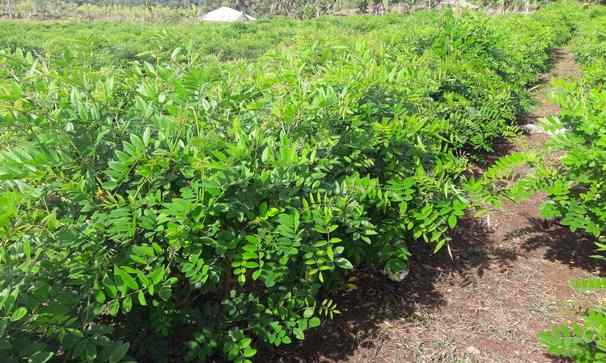
Meanwhile, the leaves on the Gamal plant are slightly pinnate with an oval leaf shape, one leaf and the other facing each other with a length of 4 to 17 cm. Apart from that, the leaves are also pointed and it is very rare to find those with a round shape.
The length of the leaves itself varies from 9 – 19 cm, where the further forward the leaves become, the more sharply conical they become, the leaves themselves consist of 7 to 17 pieces with an oblong shape facing each other, green in color and whitish on the underside of the leaves.
3. Morphology of Gamal Flowers
The next morphology is the flowers on the Gamal plant, where these flowers tend to be light red to reddish in color, and usually have yellow dots scattered around the petal area.
The flower arrangement is upright, where the flowers form a group on young and old stalks, the flower petals are round and almost stand upright with a size of 15 – 20 mm and a width of 4 – 7 mm.
The flower bouquet on this Gamal plant is in the form of a panicle containing 25 – 50 flowers with a length of approximately 5 – 12 cm, while the flower crown is purplish white with 10 stamens, usually starting to grow at the end of the dry season.
4. Morphology of Gamal Fruit
Meanwhile, the fruit of the Gamal plant itself is a green and brownish yellow pod when it is old, the fruit contains 3 to 8 seeds, has an elongated flat shape, is green when young, and yellow and brown when old, apart from that the tip has a slight black color when old.
Gamal Plant Cultivation
Actually, there are several ways to propagate this plant, firstly by spreading seeds and secondly by cuttings.
Stem cuttings are one of the most widely used methods for cultivating this plant.
A few tips if you want to do this one way, it will be better if you use the lower trunk that is over 2 years old with a trunk diameter of 4 cm and a length of 40 to 1.5 m.
Apart from that, you also have to pay attention to the planting distance, approximately 40 – 50 cm apart depending on your needs.
You should also note that by planting these cuttings, Gamal will usually grow faster, proper planting can get 90% yield from the Gamal, usually this planting is done at the end of the rainy season.
Maybe that’s all for this review regarding the Gamal plant, where Gamal is widely cultivated by garden breeders to protect their other plants such as chocolate plants to tea gardens from pests and other problems, that’s all, I hope it’s useful, thank you.
That is the explanation regarding the Classification and Morphology of Gamal Plants. Hopefully it can be useful.
All content and articles published on DomainJava.com are provided solely for informational and educational purposes. We strive to present accurate, relevant, and useful information, but it is not intended to violate any laws, policies, or guidelines. Any use of the information contained in the article Classification and Morphology of Gamal Plants is entirely the responsibility of the reader.