List of contents
Do you know about the Classification and Morphology of Jute Plants? Most of you may not be familiar with one type of plant.
Locally, the jute plant is usually known as jute, yute or molokhiyah.
The jute plant itself is actually widely distributed in various regions of Asia and Africa, such as China, India, Egypt, Libya and including Indonesia.
The jute plant in Indonesia is actually more commonly known as the kenaf plant, because it has almost the same morphological structure but is a different genus and species from the jute plant.
Kenaf is usually better known as Javanese jute. The kenaf plant is one of the plants that is widely used as a substitute for the jute plant because it has almost the same shape and function.
The jute plant itself has actually been widely cultivated since ancient Egyptian times.
This type of jute plant contains lots of vitamins, fiber and minerals, the amount of which exceeds that of other known vegetables or herbs.
This jute plant is a plant that grows well in full sun or hot weather, which will produce green vegetables throughout the summer.
The jute plant is a plant that has very fine fibers, like cotton, the jute plant can be ranked second in terms of having fine fibers after the cotton plant.
Jute varieties are generally widely used as raw material for making jute sacks, however jute plant varieties which are smaller in size are usually more widely used and consumed as vegetables, one type of which is C. Olitorius
Jute Plant Classification
The jute plant itself has a scientific or Latin name, namely Corchorus capsularis.
In other countries, the jute plant is also known by several names, such as in European areas such as France, England it is better known as Jute, while in Portugal it is known as Juta.
Next we will explain in more detail the classification of the jute plant itself:
- Kingdom (Kingdom): Plantae
- Sub Kingdom : Viridiplantae
- Infra Kingdom : Streptophyta
- Super Division: Embryophyta
- Division (Division): Tracheophyta
- Sub Division: Spermatophytina
- Class (Class): Magnoliopsida
- Above the Order: Rosanae
- Order : Malvales
- Family: Malvaceae
- Genus : Corchorus L.
- Species: Corchorus capsularis L.
Characteristics and Morphology of Jute Plants
After you know the classification of jute plants as described above, we will then discuss the characteristics and morphology of the jute plant itself, including:
1. Boy
Jute plants have straight and slender plant stems. This plant is a type of annual herbaceous plant that can continue to grow until it reaches a height of 3 to 5 meters.
The branches of the jute plant are near the top of the plant.
As mentioned above, the jute plant has fine fibers, this jute fiber is extracted from the stem of the plant.
The stem of the jute plant itself is a thick and sturdy plant stem which is often used as fiber for making burlap sacks or used to make rope and other textile materials.
2. Leaves
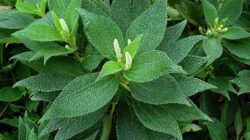
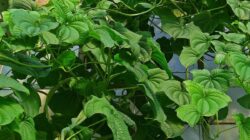
For the leaves of the jute plant, the leaves themselves have a light green color which is usually used as a vegetable for consumption.
When cooked, this vegetable will have a mild and slightly bitter taste.
The leaves of the jute plant also have a pinnate vein structure.
The leaves of the jute plant tend to grow alternately on the stem or branches.
3. Flowers
The jute plant itself is a type of plant that has flowers. The flowers are yellow in color and grow around the leaf axils of the plant.
Jute plants prefer sunlight to grow, so they grow well when summer arrives.
When the air temperature begins to decrease, the production of the leaves will begin to slow down and produce small, bright yellow flowers.
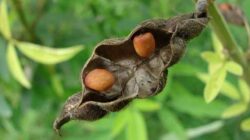
When the jute plant dries naturally, the flowers are replaced by long, thin seed pods that can be harvested.
4. Fruits and Seeds
The fruit of the jute plant itself has various shapes, for the C. capsularis fruit species it has a round and curved shape, while the C. olitorius fruit species has an elongated shape.
Both types of fruit can be propagated by planting them from seeds.
When cultivating jute plants, the soil used must be loose and the seeds spread at a plant density of 6 to 10 kg seeds/ha.
The best soil for growing is alluvial soil which has a thick solum and must have good drainage, because young jute plants will be very sensitive to standing water.
Those are some of the Classifications and Morphology of Jute Plants. Hopefully this article can be useful and further increase our knowledge regarding jute plants.
All content and articles published on DomainJava.com are provided solely for informational and educational purposes. We strive to present accurate, relevant, and useful information, but it is not intended to violate any laws, policies, or guidelines. Any use of the information contained in the article Classification and Morphology of Jute Plants is entirely the responsibility of the reader.