List of contents
Do you know about the Classification and Morphology of Terrarium Plants? Have you ever heard of terrarium plants? Maybe it sounds familiar to you with terrarium plants.
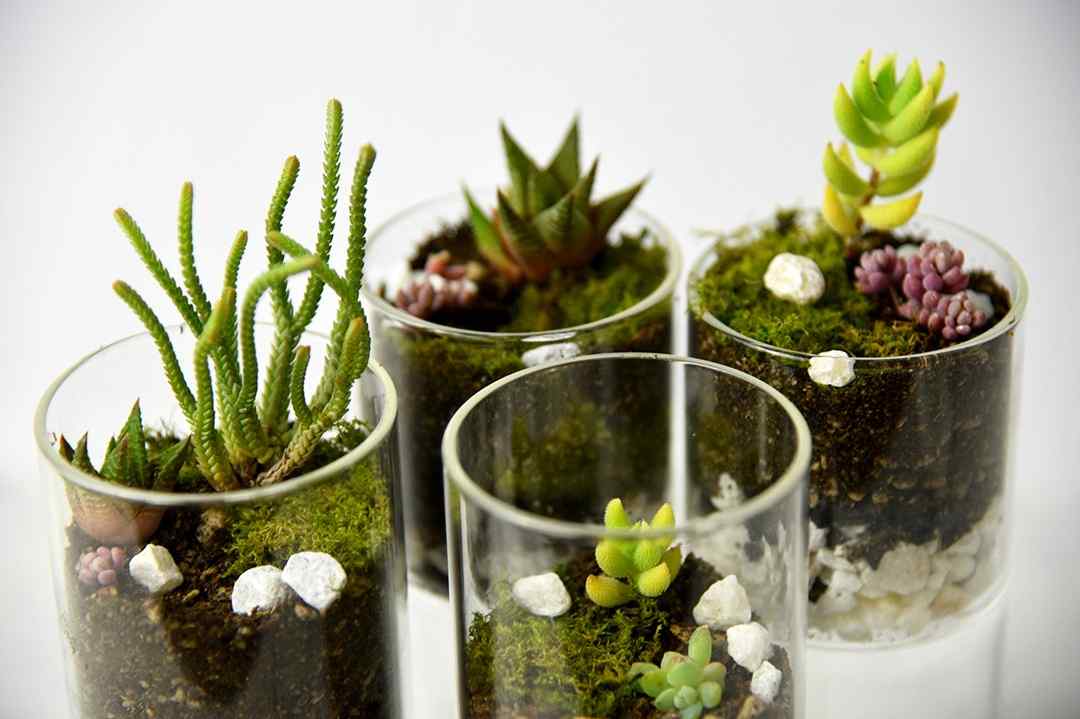
Terrarium plants are ornamental plants that are placed on a medium made of glass or transparent plastic.
Terrarium plants are often used as home decoration because of their uniqueness. The unique thing about terrarium plants is that the media or container in which the terrarium plants are placed is made to look like a mini garden.
The shape of terrarium plants varies greatly with the media or containers also varying in shape.
It is not surprising that terrarium plants have now become a profitable business because many people are interested in owning these plants.
TYPES OF TERRARIUM PLANTS
Not all types of plants can be used as terrarium plants because the size of the terrarium container is limited and plant care is kept to a minimum.
There are several types of plants that are usually used as terrarium plants.
Cactus Plant
Using cactus plants as terrarium plants is the right thing because cactus plants do not require special care, for example they do not need to be regularly watered because cactus plants do not need a lot of water.
It is best to use cactus plants for terrarium plants in open containers because if they are in closed containers the humidity level will be high.
If you want to use companion plants for cacti in your terrarium, you should choose plants that are more or less the same as cacti, that is, they don’t need a lot of water because if you combine cacti with plants that need water, it will damage the cactus because the companion plants must be watered with water.
Fern Plant
Ferns are very suitable for use as closed terrarium plants because ferns require high humidity.
Ferns are not suitable to be combined with cacti in one container because cacti cannot grow if the humidity is high.
Ivy Plant
This type of ivy plant is a climbing plant that has attractive leaf shapes, one of which is triangular in shape, the leaves are green with a yellow border.
Ivy plants require high humidity. You must pay close attention to the volume of water and the size of the container when using ivy as a terrarium plant because it has the potential to grow mold.
Crypthantus plant
The crypthantus plant is also called the earth star plant because of its circular shape like a star.
The color of the leaves of the crypthantus plant varies, for example brown, green, red and even a combination of these colors.
CLASSIFICATION OF TERRARIUM PLANTS
The following is a classification of plants that are usually used as terrarium plants, namely cactus, ferns, ivy, fittonia and crypthantus.
Classification of Cactus Plants
Cactus plants come from the kingdom Plantae, namely plants and their division is Magnoliophyta. The class of cactus plants is Magnoliopsida and the order is Caryophyllales.
The family of cactus plants is Cactaceae and the genus is Opuntia. The species of cactus plant is Opuntia Cochemmilifera.
Classification of Ferns
Ferns come from the kingdom Plantae or plants and the division Cycadophyta. The class of ferns is Cycadopsida while the order is Cycadales. The family of ferns is Cycadaceae Persoon and the genus is Cycas.
Ivy Plant Classification
The ivy plant comes from the kingdom Plantae or plants and its order is Lamiales. The family of ivy plants is Lamiaceae and the genus is Plectranthus. The species of ivy is Plectranthus Verticillatus.
Crypthantus Plant Classification
The crypthantus plant comes from the kingdom Plantae or plants and its order is Poales. The family of the Crypthantus plant is Bromeliaceae and its subfamily is Bromeliodeae. The crypthantus plant comes from the Genus Cryptanthus Otto & Dietr.
TERRARIUM PLANTS MORPHOLOGY
The following are the characteristics or morphology of cactus plants, ferns, ivy plants and crypthantus plants.
Morphology of Cactus Plants
A characteristic feature of the cactus plant is the spines all over the cactus plant. Cactus spines are a modified form of leaves that serve to protect against herbivores.
The stem of the cactus plant is coated with wax, whose function is to protect it from the heat of the sun and thicken the skin of the cactus stem so that water evaporation can be minimized.
Cactus plants have a fairly complicated root system, namely fibrous, taproot and branching roots.
Small cactus plants have large roots while large cacti have small roots.
Fern Plant Morphology
The root of the fern plant is a tap root. The shape of the stem of a fern plant is like a palm, namely upright with a diameter that can reach 30 cm.
The leaves of the fern plant are similar to a keris with compound, pinnate leaves. The fern flower is a monoecus and the fern seeds are round like a palm tree.
Ivy Plant Morphology
Ivy plants have aromatic leaves that are shiny, green, round in shape, sometimes dark purple in the middle.
Crypthantus Plant Morphology
Crypthantus plants have fragile roots and are small and branched. The leaves of the crypthanrus plant are long and dense and resemble stars in shape.
The size of the leaves of the crypthantus plant depends on the type, namely up to 40 cm and up to 4 cm wide.
The color of the leaves of the crypthantus plant is green or a combination of green, yellow, red or white stripes. The underside of the leaves of the crypthantus plant are covered with scales.
All content and articles published on DomainJava.com are provided solely for informational and educational purposes. We strive to present accurate, relevant, and useful information, but it is not intended to violate any laws, policies, or guidelines. Any use of the information contained in the article Classification and Morphology of Terrarium Plants is entirely the responsibility of the reader.